
Career management support

I’ve created two resources to help the people who have asked me for support in their job searches and in exploring potential career changes, including parents, grandparents, and coaches who are in turn supporting a child or a client. The first provides self-guided support and is free. The second is a virtual career manager application -- a virtual advisor, co-author, and task manager. I charge a fee to cover the costs of maintaining the application, and users cover their own AI usage costs.

Self-guided support

The self-guided support pages cover common work: resumes, letters, interview preparation, and professional introductions as well as cataloguing achievements, strengths, and skills. Similar resources exist on other sites. I’ve organized the material by the questions I’m frequently asked.

Answers are short — just the facts. A few provide only an insight. Most, however, also include steps you can follow yourself, and techniques you can use with a tool like ChatGPT or Claude if you want.

Answers to the Main Questions

Virtual career manager application

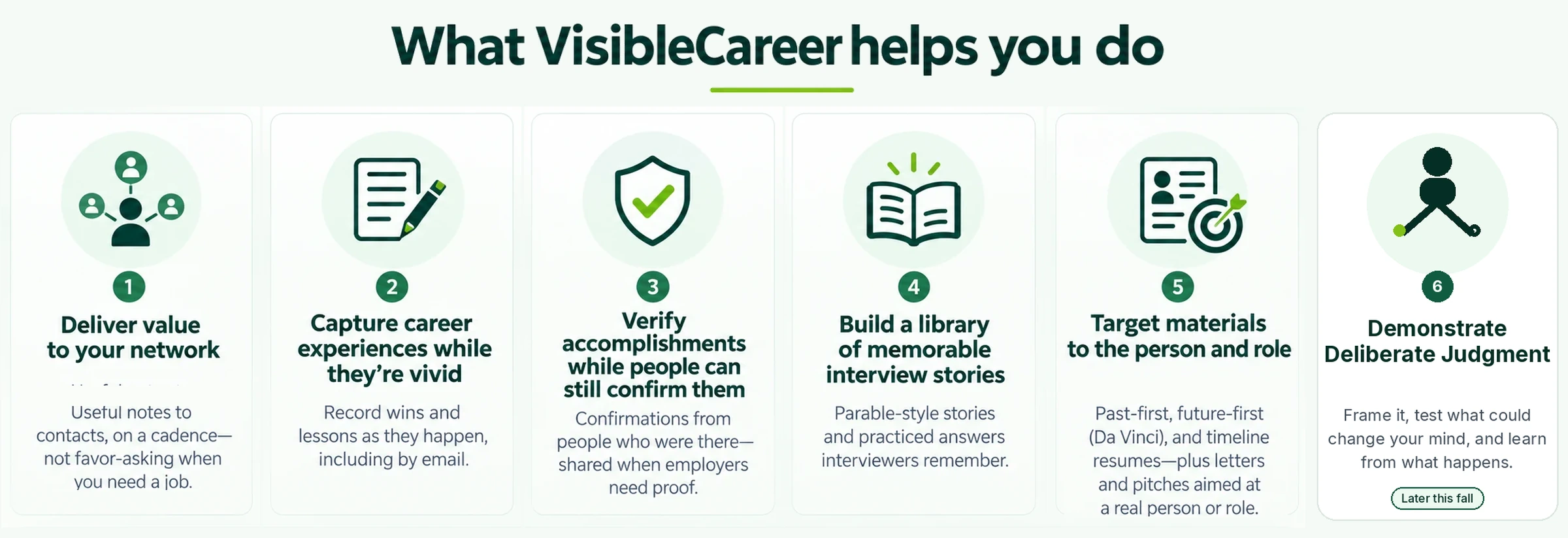
The application makes it more likely you will do the career-management work that, empirically, has a large effect on career success and pay — work most people skip because of the time it takes and their lack of comfort performing them. Here are five activities that make the biggest difference:

  1. 1. Continuously deliver value to your network

    Professionals who regularly deliver something useful to each person in their network — tailored, not generic — dramatically increase the likelihood that those contacts will proactively bring them job opportunities, and will invest much greater discretionary effort in the help they provide.

    Most professionals wait to network until they are job hunting. By then there is little chance to create value, and they have to ask for a favor anyway. Without having received value frequently in advance, even friends and close colleagues usually feel imposed on, and do less than hoped. By contrast, professionals who regularly deliver value to their network typically report that almost all of their jobs came to them from the network, not from searching themselves.

    Litmus

    • When you reach out to members of your professional network because you need support landing your next job, will they see it as an obligation or a burden, or as an opportunity to support someone who regularly gives them value they can’t ignore?
    • Do you actively track what value you have delivered to each member of your professional network, and when?
  2. 2. Capture career experiences while they are still fresh

    Professionals who pause weekly to write down experiences that show skills, strengths, and what they learned from mistakes significantly increase their ability to differentiate themselves from other candidates. Most wait until a resume is due. By then they have forgotten many of the moments that would have been useful on a resume, in a letter, or in an interview. The forgotten experiences leave them looking more like everyone else.

    Litmus

    • When you next need a resume, a letter, or an interview story, will you be reconstructing years of work from memory, or drawing on moments you already wrote down while they were still specific?
    • Do you have a written record of this month’s work that shows a skill, a strength, or a lesson — or only of the last time you updated a resume?
  3. 3. Verify claims while someone can still confirm them

    Professionals who regularly ask supervisors (or other relevant people) to certify their accomplishments and abilities significantly increase their ability to differentiate themselves from other candidates. Most people rely on references called late in a process, who usually can speak to only a limited range of their experiences. Verifying experiences as they happen makes claims something a later employer can trust.

    Litmus

    • Do you claim accomplishments and abilities — or prove them?
  4. 4. Keep a library of parables

    Professionals who keep building a set of stories that show skills and strengths in a way a listener can remember significantly increase their ability to differentiate themselves from other candidates. A parable is a story that teaches by framing the work as a lesson learned, so the professional can stay humble while demonstrating a capability.

    Litmus

    • In interviews, do you give examples, or do you tell stories that interviewers share with their colleagues and family members, potentially for years?
  5. 5. Target everything to the person and role

    Professionals who hyper-target job applications, interviews, and messages to contacts significantly increase their ability to differentiate themselves from other candidates. That is not customization in the general sense — swapping a few keywords, or sending the same story with a new company name. It is speaking to the skills, strengths, and experiences that matter specifically to each person and posting.

    Litmus

    • Do your messages, interview answers, and conversations with contacts — including people at organizations where you are pursuing a role — explicitly identify how you can help them meet their personal objectives?

What you do in the application

Subscribers can import resumes and career documents, draft Classic and Da Vinci resumes, maintain a career library, manage contacts, pursue specific roles, and more. Setup walks through the first run; COMPASS (the ? button after sign-in) answers how-to questions on any screen.

  • Import resumes, reviews, assessments, LinkedIn exports, and contact lists
  • Draft Classic and Da Vinci resumes, cover letters, pitches, and parables
  • Verify accomplishments and share proof pages
  • Run job searches and build a kit per pursuit

Capabilities

Some recent use cases

Here are a few interesting ways some friends are using the application:

  • A grandmother supporting her grandchildren

    A grandmother gifted annual subscriptions to her high school and college-age grandchildren. She scheduled time with each of them every other week to update their information. She wanted to do the work with them so they would build the habit of regularly managing their careers, and so they would spend more quality time together.

  • A father and daughter supporting one another

    An attorney started the process himself, then purchased a subscription for his daughter, who works in marketing in New York City. They speak on Sunday evenings and update each other's career experiences. They have designated each other as coaches.

  • A 50-year-old looking for career insurance

    A professional in their fifties has a job and is not looking for another one. They use the application to keep delivering useful, specific value to people in their network, so that if the job ends, those contacts already have a reason to help rather than a sudden request for a favor.

  • A mid-career sales leader

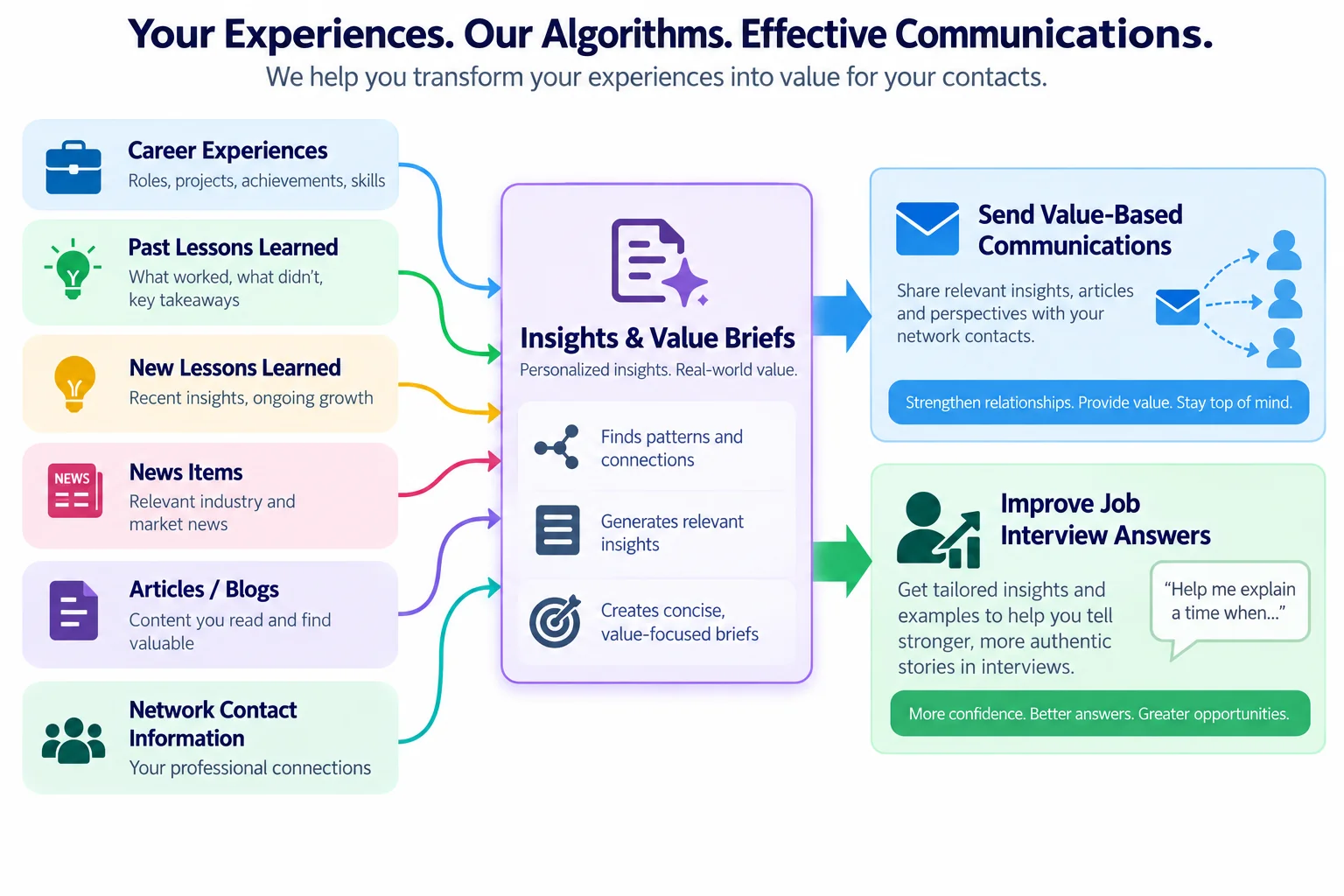
    A 40-something sales leader hired a career coach to do the initial upload of their career information and import their LinkedIn contacts. The coach works on a bi-weekly cadence with the sales leader to help them capture forgotten career experiences and parables, and build a routine for generating insights to share with the sales leader's contacts.

  • A young software engineer

    A 20-something software engineer is using the application to capture sharable project details and lessons learned whenever he completes one. He then asks the project lead to verify his write-up. He has also captured his first set of parables around recent projects.

Early positive feedback

Here are a few notes people have shared:

  • I spoke with a recruiter who had read my [forward-looking] resume I created. She told me that I sounded different than everyone else. It was a great start... The CEO told me that one of the parables I developed was what ultimately convinced him to hire me.

    Fortune 100 C-Suite Executive
  • It never occurred to me that my daughter's high school experiences actually told a compelling story. I had thought of her resume as something that was more like a scoreboard, not something that could demonstrate to a real company that she could provide real value in a summer internship.

    Parent, High School Student
  • I've been really pleased with my career coach, but now we have a platform where we can collaborate much more effectively. We get on a Zoom call, log in, and can work together quickly. The AI tools have been great tiebreakers when we don't agree. We also assign each other tasks when we aren't working together live.

    Financial Analyst, Mid-market Technology Company
  • My son landed his first job after college and is living at home to save money. Every day, I'd ask how his day was, and I'd get some version of 'fine.' It was like he had never left high school, although his tone was at least positive. Now, I'm using the application as an excuse to get him to share more about the work he is doing. I'm learning about his work. He's building out his career library and even has a few great stories now.

    Parent of Recent College Graduate in Entry-level Marketing Job
  • I'm surprised at how much my colleagues have appreciated the periodic messages I'm sending using the insight generation process in the application. They've introduced me to several other people over the past few months without me asking, including one with someone who was looking to fill a position. It wasn't the right fit for me, but I'm optimistic that it won't be the last time one of them brings me an opportunity.

    Sales Leader, Fortune 500 Company
  • I thought of my job as pretty much rinse and repeat until I started capturing project work I was completing every week. I had never appreciated how much I was learning. I'm sure writing this information down is going to help in my career, but I'm enjoying the job I have more now.

    Human Resources Generalist, Fortune 1000 company

Sign Up